Jay Kardan and Laura-Gray Street
Randolph College
Introduction by Jay Kardan
![]() PDF of Translation |
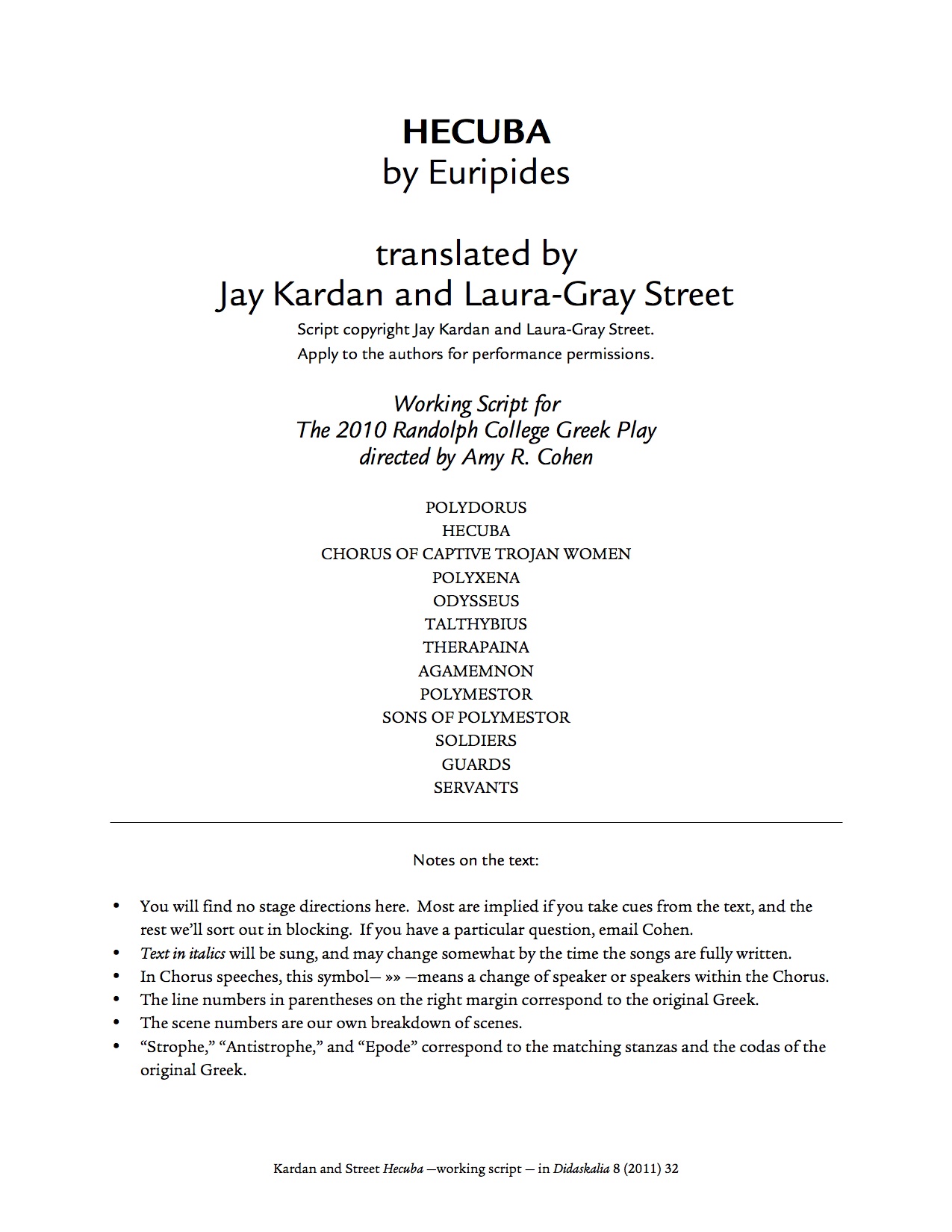
![]() PDF of Working Script |
It was late in the fall of 2008 that Laura-Gray Street and I approached Dr. Amy R. Cohen with a suggestion that we provide her with a translation of Euripides’ Hecuba to be used as a script for her production of the 2010 Randolph College Greek Play. Our interest in this project was born not of any perceived deficiency in existing published translations of the Hecuba, but rather of a wish to engage with a colleague in a start-to-finish process of creating a tailor-made script for the production of an ancient tragedy. Prof. Cohen had made cuts and alterations in the scripts used in her previous Randolph College productions, but she had always worked from existing translations, and we believe it was the opportunity to participate in crafting a script from the beginning that made her welcome our proposal.
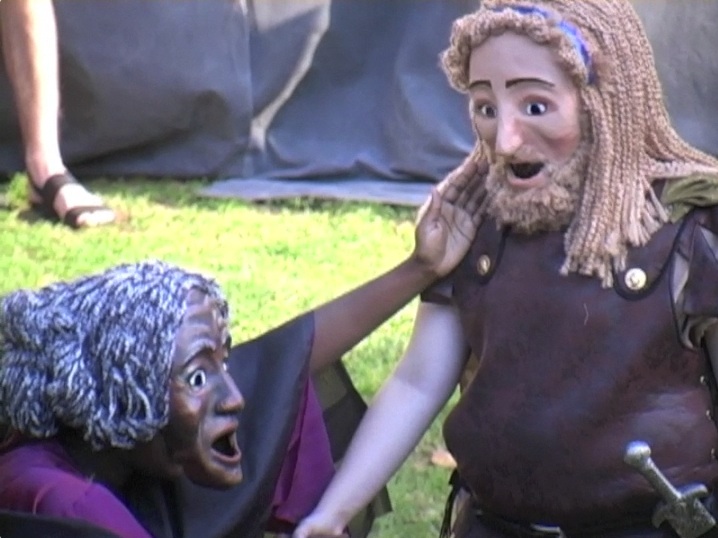
The process started with a fairly literal rendering of Euripides’ text into English by Jay Kardan, a professional translator and instructor of Latin and Greek at the college. From this preliminary version, Laura-Gray Street, a poet and professor of creative writing, prepared the first draft of a versified script, which was shown to Kardan and Cohen for their review. Then began a series of three-way conversations in which artistic and literal fidelity to the original was tempered by the exigencies of production. As rehearsals began in the summer of 2010, responsibility for shaping the script shifted appropriately along the three-collaborator line, away from Kardan and toward Cohen, who would direct the resulting play. Chris Cohen, composer of the music used in the production, and Randall Speer, the orchestrator and music director, contributed to the final form of the lyric passages. An examination of the two posted versions will reveal the ultimate differences between Street’s rendering and the working script. The accompanying video shows the ultimate product of this collaborative process.
We flatter ourselves that the result is a Hecuba uniquely adapted to the aesthetic traditions, outdoor theater, and student cast of the Randolph College Greek Play. Both translators found a satisfying challenge in the collaborative process, which enabled two writers without experience in drama to contribute to a dramatic performance and to learn something of the long road leading from an inanimate text to its staged realization.